Let's not reinvent the wheel, but look to past (or current) results of the experimentation of other types of government. Has there ever been a socialist (or even semi-leftist) government who has not dwelt in the realm of eugenics, (includes Darwinism, selective breeding, or even all-out genocide)?
I can say that the answer to this is almost unarguably NO.
Why? Well, it starts out with the fact that the government already controls more than necessary. Here is the unbiased definition of socialism straight off Dictionary.com:
An economic system in which the production and distribution of goods are controlled substantially by the government rather than by private enterprise, and in which cooperation rather than competition guides economic activity.
Now it all starts out as a well-meaning (or as Glenn Beck likes to put it) progressive movement. It originates to benefit the whole. I can't quite explain exactly how it moves from the help-the-poor round to the selective-, breeding-extinguish-the-"undesirable"(often the poor), (I don't have a PhD in Political Psychology, but George Bernard Shaw put it rather bluntly:
"A part of eugenic politics would finally land us in an extensive use of the lethal chamber. A great many people would have to be put out of existence simply because it wastes other people's time to look after them."
If the positive praise for socialism comes solely from the benefiting of the poor, then how do you explain all the socialists and communist-sympathizers views on eugenics and euthanasia? Or are there underlying motives for the movement.
If this isn't enough to convince you of the inevitable consequence of socialism, here is a link to quotes by other supporters for genocide and selective breeding: (by the way, notice the common trend,-- all "progressives", socialists, leftists, or elitists)
I'll have another post that includes an excerpt of a favorite author of mine that nails to a Tee what I've been trying to explain. It's lengthy, but definitely worth your time.
Thursday, February 11, 2010

Saturday, January 30, 2010
History Rewritten: Nazis are Right-wing???
Nazis are always labeled as right-wingers along with fascists
A correction needs to be made on the political spectrum we are taught in schools. This is how it should be. To view a link to a relevant and previous post click here.
Those who claim Hitler was right-wing never define their terms. The political spectrum comes down to the percentage of individual power vs. governmental power.
The popular author Jonah Goldberg shows the striking similarities of the communists and the National Socialists.
In fact, at the beginning of WW2, USSR and Germany had agreed to divide Poland and other Eastern Bloc countries among themselves. Another of my blog topics delves more deeply into this topic.
A correction needs to be made on the political spectrum we are taught in schools. This is how it should be. To view a link to a relevant and previous post click here.
Those who claim Hitler was right-wing never define their terms. The political spectrum comes down to the percentage of individual power vs. governmental power.
The popular author Jonah Goldberg shows the striking similarities of the communists and the National Socialists.
In fact, at the beginning of WW2, USSR and Germany had agreed to divide Poland and other Eastern Bloc countries among themselves. Another of my blog topics delves more deeply into this topic.
History Rewritten: Russia and Germany's Secret Alliance
During my 8th grade year of school we were studying one of the World Wars. My History teacher mentioned the alliances of all the countries involved. Then she mentioned Russia on the Allies' side. Earlier, I had briefly read that they had joined Germany for a short period of time even before the U.S. had entered WW2, and then had switched sides by the time 1941 rolled around. I mentioned this to my teacher, asking her to go into more detail about the subject. She replied that she had NO IDEA what I was talking about. I went into a little more detail about the subject, and she still replied that it hadn't happened.
So I delved to alternative history books that actually might mention this. I did find what I had been referring to.
It is known as the Nazi-Soviet Non-Aggression Pact, and is little, if ever mentioned in the common High School History textbook.

Here is some background on this:
On August 14, 1939, German Foreign Minister Joachim von Ribbentrop contacted the Soviets to arrange a deal. Ribbentrop met with the Soviet Foreign Minister Vyacheslav Molotov in Moscow and together they arranged two pacts - the economic agreement and the Nazi-Soviet Non-Aggression Pact.
To the chancellor of the German Reich, Herr A. Hitler.
I thank you for your letter. I hope that the German-Soviet Nonaggression Pact will mark a decisive turn for the better in the political relations between our two countries. .
J. Stalin*
The first pact was an economic agreement, which Ribbentrop and Molotov signed on August 19, 1939.

Above -- Soviet Foreign Minister Molotov signs the Nazi-Soviet Non-aggression Pact while German Foreign Minister Von Ribbentrop and Soviet leader Stalin look on under a portrait of Lenin, August 23, 1939. News of the Pact stunned the world and paved the way for the beginning of World War Two with Hitler assured the Germans would not have to fight a war on two fronts.
The economic agreement committed the Soviet Union to provide food products as well as raw materials to Germany in exchange for furnished products such as machinery from Germany.
During the first years of the war, this economic agreement helped Germany bypass the British blockade.
The Nazi-Soviet Non-Aggression Pact
On August 23, 1939, four days after the economic agreement was signed and a little over a week before the beginning of World War II, Ribbentrop and Molotov signed the Nazi-Soviet Non-Aggression Pact. (The pact is also referred to as the German-Soviet Non-Aggression Pact and the Ribbentrop-Molotov Pact.) Publicly, this agreement stated that the two countries - Germany and the Soviet Union - would not attack each other. If there were ever a problem between the two countries, it was to be handled amicably. The pact was supposed to last for ten years; it lasted for less than two.
What was meant by the terms of the pact was that if Germany attacked Poland, then the Soviet Union would not come to its aid. Thus, if Germany went to war against the West (especially France and Great Britain) over Poland, the Soviets were guaranteeing that they would not enter the war; thus not open a second front for Germany.
In addition to this agreement, Ribbentrop and Molotov added a secret protocol onto the pact - a secret addendum whose existence was denied by the Soviets until 1989.
Impacts of the Pact
When the Nazis attacked Poland in the morning on September 1, 1939, the Soviets stood by and watched. Two days later, the British declared war on Germany and World War II had begun. On September 17, the Soviets rolled into eastern Poland to occupy their "sphere of influence" designated in the secret protocol.
Because of the Nazi-Soviet Non-Aggression Pact, the Soviets did not join the fight against Germany, thus Germany was successful it its attempt to safeguard itself from a two-front war.
The Nazis and the Soviets kept the terms of the pact and the protocol until Germany's surprise attack and invasion of the Soviet Union on June 22, 1941.
* Letter to Adolf Hitler from Joseph Stalin as quoted in Alan Bullock, Hitler and Stalin: Parallel Lives (New York: Vintage Books, 1993) 611.
So I delved to alternative history books that actually might mention this. I did find what I had been referring to.
It is known as the Nazi-Soviet Non-Aggression Pact, and is little, if ever mentioned in the common High School History textbook.
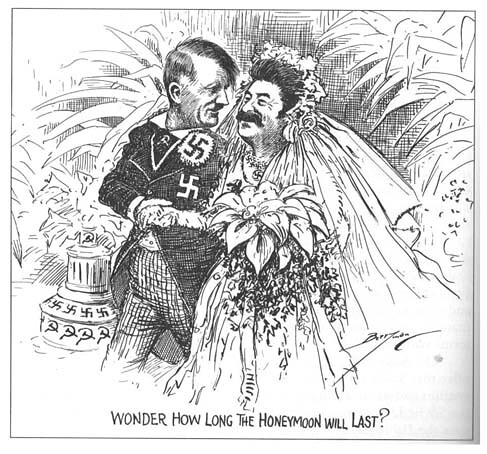
Here is some background on this:
On August 14, 1939, German Foreign Minister Joachim von Ribbentrop contacted the Soviets to arrange a deal. Ribbentrop met with the Soviet Foreign Minister Vyacheslav Molotov in Moscow and together they arranged two pacts - the economic agreement and the Nazi-Soviet Non-Aggression Pact.
To the chancellor of the German Reich, Herr A. Hitler.
I thank you for your letter. I hope that the German-Soviet Nonaggression Pact will mark a decisive turn for the better in the political relations between our two countries. .
J. Stalin*
The first pact was an economic agreement, which Ribbentrop and Molotov signed on August 19, 1939.
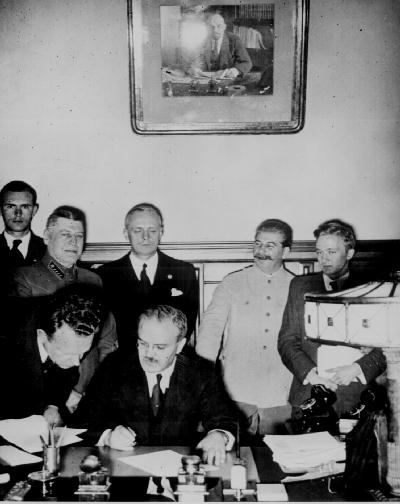
Above -- Soviet Foreign Minister Molotov signs the Nazi-Soviet Non-aggression Pact while German Foreign Minister Von Ribbentrop and Soviet leader Stalin look on under a portrait of Lenin, August 23, 1939. News of the Pact stunned the world and paved the way for the beginning of World War Two with Hitler assured the Germans would not have to fight a war on two fronts.
The economic agreement committed the Soviet Union to provide food products as well as raw materials to Germany in exchange for furnished products such as machinery from Germany.
During the first years of the war, this economic agreement helped Germany bypass the British blockade.
The Nazi-Soviet Non-Aggression Pact
On August 23, 1939, four days after the economic agreement was signed and a little over a week before the beginning of World War II, Ribbentrop and Molotov signed the Nazi-Soviet Non-Aggression Pact. (The pact is also referred to as the German-Soviet Non-Aggression Pact and the Ribbentrop-Molotov Pact.) Publicly, this agreement stated that the two countries - Germany and the Soviet Union - would not attack each other. If there were ever a problem between the two countries, it was to be handled amicably. The pact was supposed to last for ten years; it lasted for less than two.
What was meant by the terms of the pact was that if Germany attacked Poland, then the Soviet Union would not come to its aid. Thus, if Germany went to war against the West (especially France and Great Britain) over Poland, the Soviets were guaranteeing that they would not enter the war; thus not open a second front for Germany.
In addition to this agreement, Ribbentrop and Molotov added a secret protocol onto the pact - a secret addendum whose existence was denied by the Soviets until 1989.
Impacts of the Pact
When the Nazis attacked Poland in the morning on September 1, 1939, the Soviets stood by and watched. Two days later, the British declared war on Germany and World War II had begun. On September 17, the Soviets rolled into eastern Poland to occupy their "sphere of influence" designated in the secret protocol.
Because of the Nazi-Soviet Non-Aggression Pact, the Soviets did not join the fight against Germany, thus Germany was successful it its attempt to safeguard itself from a two-front war.
The Nazis and the Soviets kept the terms of the pact and the protocol until Germany's surprise attack and invasion of the Soviet Union on June 22, 1941.
* Letter to Adolf Hitler from Joseph Stalin as quoted in Alan Bullock, Hitler and Stalin: Parallel Lives (New York: Vintage Books, 1993) 611.
The Importance of True History
Read no history: nothing but biography, for that is life without theory. --Benjamin Disraeli
Those who cannot learn from history are doomed to repeat it.--George Santayana
The past is malleable and flexible, changing as our recollection interprets and re-explains what has happened. --Peter Berger
All history becomes subjective; in other words there is properly no history, only biography.--Ralph Waldo Emerson
“That men do not learn very much from the lessons of history is the most important of all the lessons that History has to teach”--Aldous Huxley quotes (English Novelist and Critic, 1894-1963)
“If I have seen further than others, it is by standing upon the shoulders of giants.”
--Isaac Newton quotes (English Mathematician and Physicist, "father of the modern science", 1642-1727)
“History has informed us that bodies of men as well as individuals are susceptible of the spirit of tyranny” --Thomas Jefferson quotes (American 3rd US President (1801-09). Author of the Declaration of Independence. 1762-1826)
Rewriting of History: Future Blog Topics
Here is a list of future blog topics I hope to cover:
-Russia and Germany's secret WW2 alliance
-Why Socialism is not on the Polar Opposite
-The Holodomor
-The Real Che
-The Color Change of the Political parties
-Vietnam as its never told
-The Atom Bomb as a solution- (not that terrible guilt-trip story I've been taught in schools)
-Bilderbergers and Trilateral Commission (yes, this one is pretty radical)
-The Distraction of the Two-Party system
-Freedom vs. Totalitarianism (my argument against the freedom
-Discriminative Nobel Peace Prize (How only radicals are nominated, ex., Obama, Jimmy Carter, George Bernard Shaw-- go figure!)
-The Nobel Peace Prize Conservative Alternative
-The Irony of the Nobel Award (Funded by dynamite and going to all the "Peace-necks" out there)
-Liberty or Security- Pick ONE
-Russia and Germany's secret WW2 alliance
-Why Socialism is not on the Polar Opposite
-The Holodomor
-The Real Che
-The Color Change of the Political parties
-Vietnam as its never told
-The Atom Bomb as a solution- (not that terrible guilt-trip story I've been taught in schools)
-Bilderbergers and Trilateral Commission (yes, this one is pretty radical)
-The Distraction of the Two-Party system
-Freedom vs. Totalitarianism (my argument against the freedom
-Discriminative Nobel Peace Prize (How only radicals are nominated, ex., Obama, Jimmy Carter, George Bernard Shaw-- go figure!)
-The Nobel Peace Prize Conservative Alternative
-The Irony of the Nobel Award (Funded by dynamite and going to all the "Peace-necks" out there)
-Liberty or Security- Pick ONE
Friday, January 29, 2010
More on the True Political Spectrum
Varying views on the political spectrum exist.
Here is a highly controversial political spectrum, in which it raises more questions than it answers.

This makes a little more sense than the last spectrum does, but it still makes my head hurt. Nothing is evenly proportioned.

The one I was always taught was the Nazis and Fascists on the Right-Wing and the Communists on the left. This is the most common political spectrum, and the most inaccurate one.

After seeing how controversial these can be, and how unclear they are, it should make your head hurt.
But this is the one I find that makes so much sense. It puts politics on a clear level, showing the left as more governmental power and less individual power, and the right as less governmental power and more individual power.

Here is a highly controversial political spectrum, in which it raises more questions than it answers.

This makes a little more sense than the last spectrum does, but it still makes my head hurt. Nothing is evenly proportioned.

The one I was always taught was the Nazis and Fascists on the Right-Wing and the Communists on the left. This is the most common political spectrum, and the most inaccurate one.

After seeing how controversial these can be, and how unclear they are, it should make your head hurt.
But this is the one I find that makes so much sense. It puts politics on a clear level, showing the left as more governmental power and less individual power, and the right as less governmental power and more individual power.

The Color Change: Hiding the "Red" factor
We often wonder why the two major political parties were given the colors they were. Red- Republican
Blue-Democrat
It wasn't always this way.
RED STATE BLUES
Did I Miss That Memo?
May 27, 2004
CLARK BENSEN1
POLIDATA ® Political Data Analysis
Over the past quarter of a century I have generated hundreds, nay thousands, of colorcoded (thematic) maps illustrating political behavior for the nation. These maps have used election results as the source information and show the geographic distribution of voter preferences at various levels of political geography, state, county, town/city, precinct and congressional or legislative districts2. In every one of these maps that indicate a political dichotomy of Republican vs. Democrat, the traditional color-coding scheme has been used: BLUE FOR REPUBLICAN, RED FOR DEMOCRAT. When I first came to Washington following the 1980 elections to join the staff of the Republican National Committee, it was already a given that color-coded maps were generated in this fashion. In fact, having watched network news election night coverage over the years, this seemed to be a generally-accepted standard. As the elections ticked away, however, the networks started to change and one-by-one the new election night standard generally became just the reverse.
As we know, the color red is more “eye-catching” and perhaps it made graphic sense for the networks to color-in the vast Republican expanse of the country in red to create a more dramatic background map. However, the problem has now transformed itself into a shorthand notation whereby the color is not used solely to visually differentiate states or counties. It is on the verge of becoming a part of the political lexicon as commentators refer to the “red states” and the “blue states”. This is, to me, as a longstanding political operative, not only confusing
but a disturbing trend of how the political paradigm has shifted. There are two general reasons why blue for Republican and Red for Democrat make the most sense: connotation and practice. First, there has been a generally understood meaning to
the two colors inasmuch as they relate to politics. That is, the cooler color blue more closely represented the rational thinker and cold-hearted and the hotter red more closely represented the passionate and hot-blooded. This would translate into blue for Republicans and red for Democrats. Put another way, red was also the color most associated with socialism and the party of the Democrats was clearly the more socialistic of the two major parties. The second reason why blue for Republicans makes sense is that traditional political mapmakers have used blue for the modern-day Republicans, and the Federalists before that, throughout the 20th century3. Perhaps this was a holdover from the days of the Civil War when
the predominantly Republican North was “Blue”. While not a unanimous practice4, there is significant printed evidence of tradition in favor of the blue for Republican and red for Democrat color scheme. Nevertheless, the networks appear to be making this change full-bore during 2004. Even some conservative commentators5 have begun to use the “red state/blue state” break as a shorthand to “Republican state/Democrat state” as part of their terminology. Moreover, some younger political observers have been exposed only to the red for Republican scheme6. Of course, while this just shrieks of inside-the-beltway elitism, it also tends to confuse the debate for many average Americans, especially those over 30. The sole premise for this short-hand is the color-coding of the maps, most of which have not been seen since the 2000 election night/recount coverage. The political parties have invested untold millions in brand recognition for their party labels. Now the media are poised to turn this around for the sake of inside Washington jargon.
Blue-Democrat
It wasn't always this way.
RED STATE BLUES
Did I Miss That Memo?
May 27, 2004
CLARK BENSEN1
POLIDATA ® Political Data Analysis
Over the past quarter of a century I have generated hundreds, nay thousands, of colorcoded (thematic) maps illustrating political behavior for the nation. These maps have used election results as the source information and show the geographic distribution of voter preferences at various levels of political geography, state, county, town/city, precinct and congressional or legislative districts2. In every one of these maps that indicate a political dichotomy of Republican vs. Democrat, the traditional color-coding scheme has been used: BLUE FOR REPUBLICAN, RED FOR DEMOCRAT. When I first came to Washington following the 1980 elections to join the staff of the Republican National Committee, it was already a given that color-coded maps were generated in this fashion. In fact, having watched network news election night coverage over the years, this seemed to be a generally-accepted standard. As the elections ticked away, however, the networks started to change and one-by-one the new election night standard generally became just the reverse.
As we know, the color red is more “eye-catching” and perhaps it made graphic sense for the networks to color-in the vast Republican expanse of the country in red to create a more dramatic background map. However, the problem has now transformed itself into a shorthand notation whereby the color is not used solely to visually differentiate states or counties. It is on the verge of becoming a part of the political lexicon as commentators refer to the “red states” and the “blue states”. This is, to me, as a longstanding political operative, not only confusing
but a disturbing trend of how the political paradigm has shifted. There are two general reasons why blue for Republican and Red for Democrat make the most sense: connotation and practice. First, there has been a generally understood meaning to
the two colors inasmuch as they relate to politics. That is, the cooler color blue more closely represented the rational thinker and cold-hearted and the hotter red more closely represented the passionate and hot-blooded. This would translate into blue for Republicans and red for Democrats. Put another way, red was also the color most associated with socialism and the party of the Democrats was clearly the more socialistic of the two major parties. The second reason why blue for Republicans makes sense is that traditional political mapmakers have used blue for the modern-day Republicans, and the Federalists before that, throughout the 20th century3. Perhaps this was a holdover from the days of the Civil War when
the predominantly Republican North was “Blue”. While not a unanimous practice4, there is significant printed evidence of tradition in favor of the blue for Republican and red for Democrat color scheme. Nevertheless, the networks appear to be making this change full-bore during 2004. Even some conservative commentators5 have begun to use the “red state/blue state” break as a shorthand to “Republican state/Democrat state” as part of their terminology. Moreover, some younger political observers have been exposed only to the red for Republican scheme6. Of course, while this just shrieks of inside-the-beltway elitism, it also tends to confuse the debate for many average Americans, especially those over 30. The sole premise for this short-hand is the color-coding of the maps, most of which have not been seen since the 2000 election night/recount coverage. The political parties have invested untold millions in brand recognition for their party labels. Now the media are poised to turn this around for the sake of inside Washington jargon.
Subscribe to:
Posts (Atom)
