Nazis are always labeled as right-wingers along with fascists
A correction needs to be made on the political spectrum we are taught in schools. This is how it should be. To view a link to a relevant and previous post click here.
Those who claim Hitler was right-wing never define their terms. The political spectrum comes down to the percentage of individual power vs. governmental power.
The popular author Jonah Goldberg shows the striking similarities of the communists and the National Socialists.
In fact, at the beginning of WW2, USSR and Germany had agreed to divide Poland and other Eastern Bloc countries among themselves. Another of my blog topics delves more deeply into this topic.
Showing posts with label nazism. Show all posts
Showing posts with label nazism. Show all posts
Saturday, January 30, 2010

History Rewritten: Russia and Germany's Secret Alliance
During my 8th grade year of school we were studying one of the World Wars. My History teacher mentioned the alliances of all the countries involved. Then she mentioned Russia on the Allies' side. Earlier, I had briefly read that they had joined Germany for a short period of time even before the U.S. had entered WW2, and then had switched sides by the time 1941 rolled around. I mentioned this to my teacher, asking her to go into more detail about the subject. She replied that she had NO IDEA what I was talking about. I went into a little more detail about the subject, and she still replied that it hadn't happened.
So I delved to alternative history books that actually might mention this. I did find what I had been referring to.
It is known as the Nazi-Soviet Non-Aggression Pact, and is little, if ever mentioned in the common High School History textbook.

Here is some background on this:
On August 14, 1939, German Foreign Minister Joachim von Ribbentrop contacted the Soviets to arrange a deal. Ribbentrop met with the Soviet Foreign Minister Vyacheslav Molotov in Moscow and together they arranged two pacts - the economic agreement and the Nazi-Soviet Non-Aggression Pact.
To the chancellor of the German Reich, Herr A. Hitler.
I thank you for your letter. I hope that the German-Soviet Nonaggression Pact will mark a decisive turn for the better in the political relations between our two countries. .
J. Stalin*
The first pact was an economic agreement, which Ribbentrop and Molotov signed on August 19, 1939.

Above -- Soviet Foreign Minister Molotov signs the Nazi-Soviet Non-aggression Pact while German Foreign Minister Von Ribbentrop and Soviet leader Stalin look on under a portrait of Lenin, August 23, 1939. News of the Pact stunned the world and paved the way for the beginning of World War Two with Hitler assured the Germans would not have to fight a war on two fronts.
The economic agreement committed the Soviet Union to provide food products as well as raw materials to Germany in exchange for furnished products such as machinery from Germany.
During the first years of the war, this economic agreement helped Germany bypass the British blockade.
The Nazi-Soviet Non-Aggression Pact
On August 23, 1939, four days after the economic agreement was signed and a little over a week before the beginning of World War II, Ribbentrop and Molotov signed the Nazi-Soviet Non-Aggression Pact. (The pact is also referred to as the German-Soviet Non-Aggression Pact and the Ribbentrop-Molotov Pact.) Publicly, this agreement stated that the two countries - Germany and the Soviet Union - would not attack each other. If there were ever a problem between the two countries, it was to be handled amicably. The pact was supposed to last for ten years; it lasted for less than two.
What was meant by the terms of the pact was that if Germany attacked Poland, then the Soviet Union would not come to its aid. Thus, if Germany went to war against the West (especially France and Great Britain) over Poland, the Soviets were guaranteeing that they would not enter the war; thus not open a second front for Germany.
In addition to this agreement, Ribbentrop and Molotov added a secret protocol onto the pact - a secret addendum whose existence was denied by the Soviets until 1989.
Impacts of the Pact
When the Nazis attacked Poland in the morning on September 1, 1939, the Soviets stood by and watched. Two days later, the British declared war on Germany and World War II had begun. On September 17, the Soviets rolled into eastern Poland to occupy their "sphere of influence" designated in the secret protocol.
Because of the Nazi-Soviet Non-Aggression Pact, the Soviets did not join the fight against Germany, thus Germany was successful it its attempt to safeguard itself from a two-front war.
The Nazis and the Soviets kept the terms of the pact and the protocol until Germany's surprise attack and invasion of the Soviet Union on June 22, 1941.
* Letter to Adolf Hitler from Joseph Stalin as quoted in Alan Bullock, Hitler and Stalin: Parallel Lives (New York: Vintage Books, 1993) 611.
So I delved to alternative history books that actually might mention this. I did find what I had been referring to.
It is known as the Nazi-Soviet Non-Aggression Pact, and is little, if ever mentioned in the common High School History textbook.
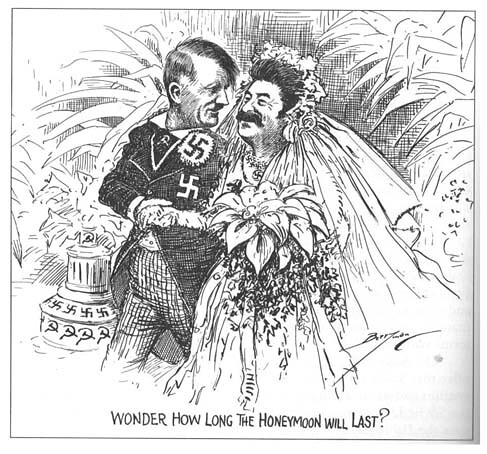
Here is some background on this:
On August 14, 1939, German Foreign Minister Joachim von Ribbentrop contacted the Soviets to arrange a deal. Ribbentrop met with the Soviet Foreign Minister Vyacheslav Molotov in Moscow and together they arranged two pacts - the economic agreement and the Nazi-Soviet Non-Aggression Pact.
To the chancellor of the German Reich, Herr A. Hitler.
I thank you for your letter. I hope that the German-Soviet Nonaggression Pact will mark a decisive turn for the better in the political relations between our two countries. .
J. Stalin*
The first pact was an economic agreement, which Ribbentrop and Molotov signed on August 19, 1939.
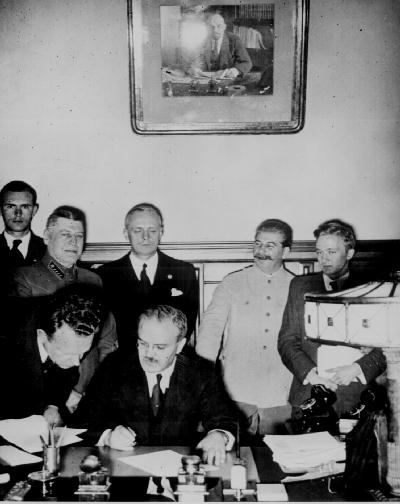
Above -- Soviet Foreign Minister Molotov signs the Nazi-Soviet Non-aggression Pact while German Foreign Minister Von Ribbentrop and Soviet leader Stalin look on under a portrait of Lenin, August 23, 1939. News of the Pact stunned the world and paved the way for the beginning of World War Two with Hitler assured the Germans would not have to fight a war on two fronts.
The economic agreement committed the Soviet Union to provide food products as well as raw materials to Germany in exchange for furnished products such as machinery from Germany.
During the first years of the war, this economic agreement helped Germany bypass the British blockade.
The Nazi-Soviet Non-Aggression Pact
On August 23, 1939, four days after the economic agreement was signed and a little over a week before the beginning of World War II, Ribbentrop and Molotov signed the Nazi-Soviet Non-Aggression Pact. (The pact is also referred to as the German-Soviet Non-Aggression Pact and the Ribbentrop-Molotov Pact.) Publicly, this agreement stated that the two countries - Germany and the Soviet Union - would not attack each other. If there were ever a problem between the two countries, it was to be handled amicably. The pact was supposed to last for ten years; it lasted for less than two.
What was meant by the terms of the pact was that if Germany attacked Poland, then the Soviet Union would not come to its aid. Thus, if Germany went to war against the West (especially France and Great Britain) over Poland, the Soviets were guaranteeing that they would not enter the war; thus not open a second front for Germany.
In addition to this agreement, Ribbentrop and Molotov added a secret protocol onto the pact - a secret addendum whose existence was denied by the Soviets until 1989.
Impacts of the Pact
When the Nazis attacked Poland in the morning on September 1, 1939, the Soviets stood by and watched. Two days later, the British declared war on Germany and World War II had begun. On September 17, the Soviets rolled into eastern Poland to occupy their "sphere of influence" designated in the secret protocol.
Because of the Nazi-Soviet Non-Aggression Pact, the Soviets did not join the fight against Germany, thus Germany was successful it its attempt to safeguard itself from a two-front war.
The Nazis and the Soviets kept the terms of the pact and the protocol until Germany's surprise attack and invasion of the Soviet Union on June 22, 1941.
* Letter to Adolf Hitler from Joseph Stalin as quoted in Alan Bullock, Hitler and Stalin: Parallel Lives (New York: Vintage Books, 1993) 611.
Friday, January 29, 2010
More on the True Political Spectrum
Varying views on the political spectrum exist.
Here is a highly controversial political spectrum, in which it raises more questions than it answers.

This makes a little more sense than the last spectrum does, but it still makes my head hurt. Nothing is evenly proportioned.

The one I was always taught was the Nazis and Fascists on the Right-Wing and the Communists on the left. This is the most common political spectrum, and the most inaccurate one.

After seeing how controversial these can be, and how unclear they are, it should make your head hurt.
But this is the one I find that makes so much sense. It puts politics on a clear level, showing the left as more governmental power and less individual power, and the right as less governmental power and more individual power.

Here is a highly controversial political spectrum, in which it raises more questions than it answers.

This makes a little more sense than the last spectrum does, but it still makes my head hurt. Nothing is evenly proportioned.

The one I was always taught was the Nazis and Fascists on the Right-Wing and the Communists on the left. This is the most common political spectrum, and the most inaccurate one.

After seeing how controversial these can be, and how unclear they are, it should make your head hurt.
But this is the one I find that makes so much sense. It puts politics on a clear level, showing the left as more governmental power and less individual power, and the right as less governmental power and more individual power.

Subscribe to:
Posts (Atom)
